Patients search for a symptom — a tooth that hurts, bleeding gums, a gap — not for the clinical name of the treatment they need.
Menu
Symptom-led patient acquisition
Letting patients describe the symptom instead of guessing the treatment name.
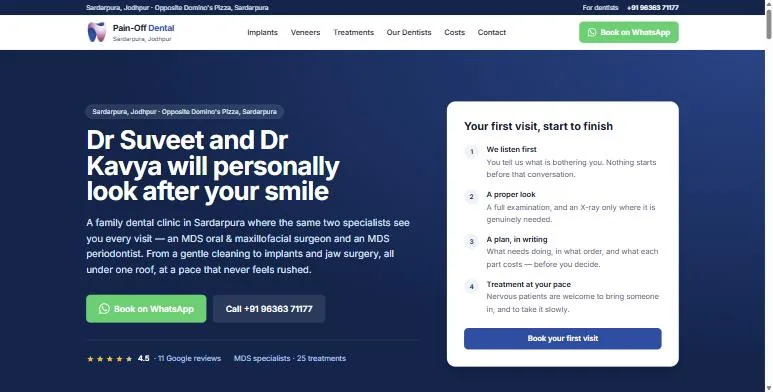
A patient-focused clinic website built around how people actually search for dental help — by what hurts — then routed to the right treatment, a named specialist and a written cost before anything is booked.
painoffdentalclinic.vercel.app
4.5★From 11 Google reviews shown on site
25Treatments documented
2Named MDS specialists
The commercial challenge
A digital journey shaped around how this customer actually decides.
Much of the local audience reads and searches in Hindi as well as English, so an English-only journey excludes part of the market.
Dental enquiries stall on two unspoken questions: what will this cost, and who will actually treat me?
Conversion design
Three decisions that make the experience easier to trust and act on.
Start from the symptom, in both languages
A grid of complaints written in plain English and Hindi maps each one to the treatment page that answers it, so nobody has to know the clinical term first.
Name the specialist before the booking
Both dentists, their MDS qualifications and which treatments sit with each are stated up front, so the visitor knows who they will see.
Put cost in writing early
The first-visit sequence promises a written plan with per-item costs before the patient decides, and the site repeats it rather than hiding it behind an enquiry.
CRM and lead management
The website does not stop when somebody submits a form.
Lead capture is connected to a workflow designed to preserve context, ownership and the next action. We can work inside the client’s existing CRM—including GoHighLevel, Zoho, HubSpot, Salesforce, Pipedrive and other API-ready systems—or build a tailored solution when the workflow genuinely requires it.
- 01
Capture
WhatsApp is the primary channel, so a patient can describe the problem and send a photo without committing to an appointment.
- 02
Qualify
The symptom that brought them in is known before the reply, so the clinic can give a realistic cost range up front.
- 03
Convert
Urgent cases route to same-day appointments while routine enquiries follow the published first-visit sequence.
- 04
Refer
A separate pathway lets other dentists in the city refer surgical cases rather than compete with them.
Google and AI discovery
Useful structure for people, search engines and answer engines.
- A page per treatment covering what it involves, visit count and cost
- Symptom-phrased entry points in English and Hindi
- Suburb-level coverage across Jodhpur with travel times
- Landmark-based location content for addresses that are hard to find by number
- Specialist and implant topic depth beyond general dentistry
- Explicit clinic, practitioner, qualification and location facts
- Direct answers to symptom and cost questions
- Consistent treatment naming across symptom, treatment and specialist pages
- Clear scope boundaries between everyday, specialist and surgical care
- Structured service and location information that can be read accurately
What the system enables
A bilingual, symptom-first journey that turns an uncertain complaint into a specific treatment page, a named dentist and a low-commitment WhatsApp conversation.
✓A route from a vague symptom to a specific treatment page
✓Access for Hindi-speaking patients searching in their own words
✓Fewer abandoned enquiries caused by unclear cost
✓A referral channel from other dental practices
This case study documents the implemented experience and publicly presented business facts. No audited before-and-after traffic, ranking, lead or revenue dataset was supplied, so we do not claim a quantified performance uplift.
Have a complicated growth journey?